Chinook Auto Sales, Calgary
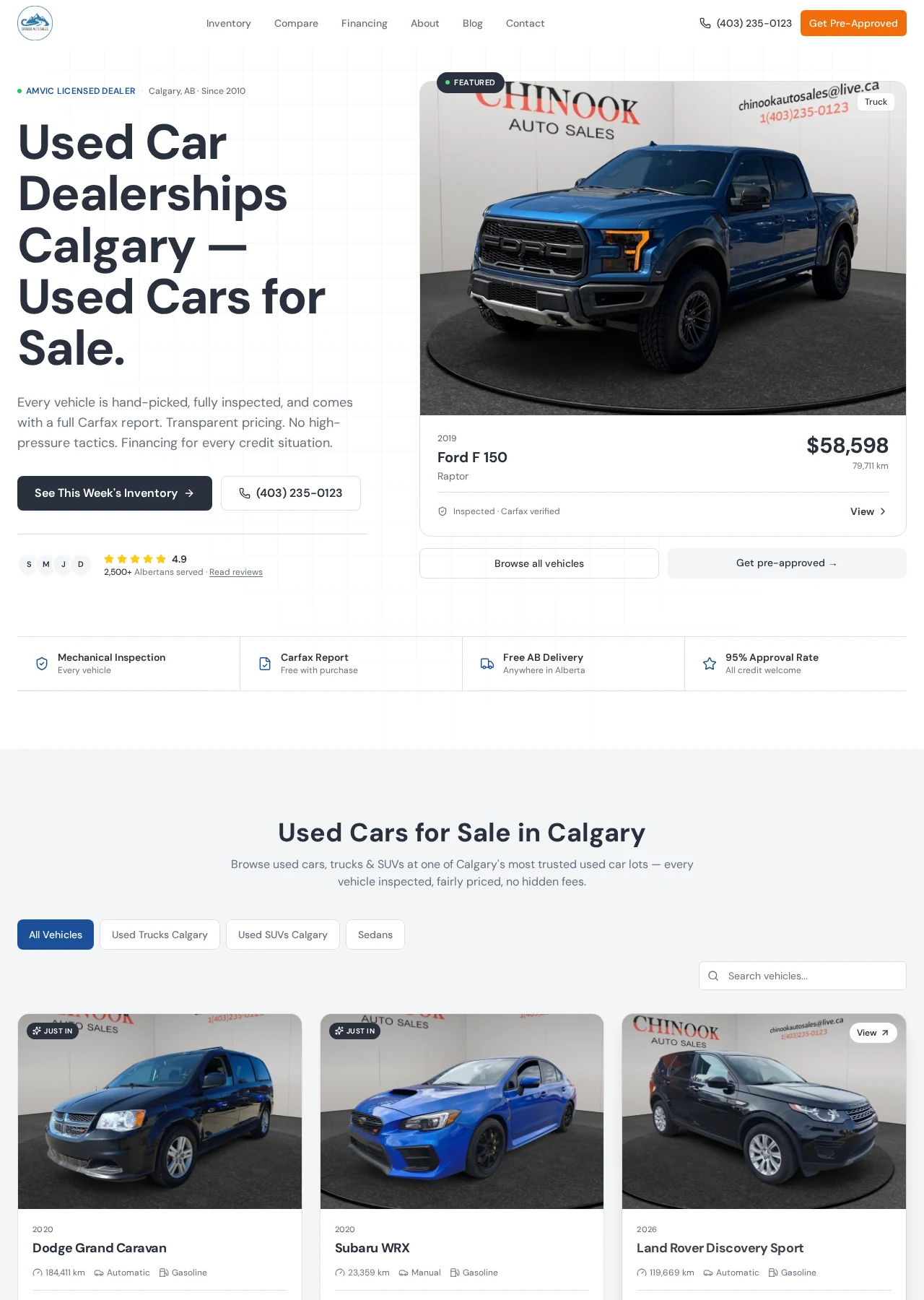
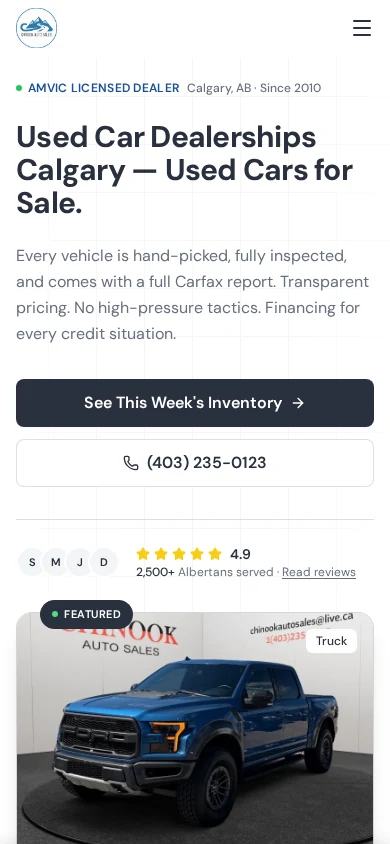
A used-car dealership whose website listed inventory and gave nobody a way to act on it. Four months after the rebuild, 260 enquiries had come through forms that did not previously exist.
260
Enquiries through the website
From none - the previous site had no form
254
Direction requests
Counted, not compared - no baseline period
How to verify this
Chinook Auto Sales agreed to be named, which means you can do the thing a case study is actually for: ring them and ask whether any of this is true. They are on 50 Street SE in Calgary and their number is on their own website, and they wrote about the rebuild on the Chinook Auto Sales blog. Everything below is sourced the same way our anonymous study is - each figure names the system it came from and the window it covers, every percentage is computed from the two numbers printed beside it rather than typed in by us, and the counted figures carry no percentage at all, because a count with no baseline does not have one.
The brief
The dealership had a website that listed cars and gave a visitor no way to act on any of them. There was no enquiry form, no finance application, and nothing that turned somebody looking at a used Forester at eleven at night into a name in an inbox the next morning. Inventory sat on a single grid page, so the site could compete for one broad query and nothing else. The brief was a full rebuild: a page per vehicle that could rank on its own, working forms including a finance path, and the local search work to put the profile in front of people shopping for a car in southeast Calgary.
What we did
Give every vehicle a page that can rank on its own
Year, make and model in the URL, the heading and the structured data, with the real photographs and the actual price rather than a call-for-pricing placeholder. One inventory grid competes for one query. A page per car competes for the query a buyer actually types, which is almost always a specific vehicle rather than a category.
Put the form on the page the buyer is already looking at
Enquiry and finance forms on the vehicle page itself, not behind a contact link in the navigation. Somebody deciding about a specific car at eleven at night will not go looking for a contact page, and asking them to is where most dealership sites quietly lose the lead.
Compete where car buyers actually search
Buyers search by manufacturer and by the dealership down the road, not by the name of a lot they have never heard of. The profile and the site were built to surface on those searches instead of only on the business name, which is the difference between being found and being looked up.
Report the actions, not the impressions
Form submissions, calls and direction requests, counted separately and reported monthly. Impressions and keyword counts are on this page too, further down, where a reach number belongs.
The profile is being found on other dealerships' names
The most useful thing in the local data is not the view count, it is what people typed to arrive. The largest discovery terms are manufacturer and competitor searches rather than the dealership's own name - Toyota in Calgary, a named competing dealer group, Mitsubishi, Nissan, used cars in Calgary, Toyota dealership in Calgary. That matters because a profile that only surfaces on its own business name is being looked up by people who already knew it existed. Surfacing on the searches a buyer runs before they have chosen anyone is the part that grows a business, and it is much harder to achieve.
Why the leads number is counted rather than compared
There is no percentage next to 260 enquiries because there is nothing to divide by. The previous website had no enquiry form at all, so the honest baseline is zero, and a percentage change from zero is not a number - it is a way of writing infinity that looks like a statistic. Any results page that shows you a percentage next to a figure that started at nothing is either confused or counting on you not to check. The count and the window are the whole claim here.
What these numbers do not show
Four things worth knowing before you weigh any of this. The organic click figure is a twelve-month total rather than a monthly rate, which works out at roughly 140 a month - if you see that number quoted as monthly anywhere, including by us, it is wrong. The search figures come from our reporting export rather than a raw Search Console download, and we would rather say so than imply a level of verification we have not done; the profile figures are raw and reconcile exactly. Enquiry volume is not sales, and how many of those 260 became cars off the lot is the dealership's number rather than ours. And the business had genuine room to grow, because a site with no form converts nobody - the same work on a dealership that already had a functioning enquiry path would not produce a comparable jump.
Search impressions
+103%
40,100 → 81,500
Reach, not revenue. It is here for completeness rather than as the argument.
- Source
- Google Search Console
- Window
- 12 months to 15 December 2025
- Against
- the preceding comparable period
Keywords ranking
+121%
2,800 → 6,200
Distinct queries the site appeared for, which is what a page per vehicle buys.
- Source
- Google Search Console
- Window
- 12 months to 15 December 2025
- Against
- the preceding comparable period
Organic clicks
+34%
1,268 → 1,700
A twelve-month total, not a monthly one. Roughly 140 a month, and worth stating plainly because a yearly figure read as a monthly one is how results pages end up overstating by an order of magnitude.
- Source
- Google Search Console
- Window
- 12 months to 15 December 2025
- Against
- the preceding comparable period
Counted, not compared
These have no percentage beside them because they have no baseline to divide by. Stating a change from nothing as a percentage is the oldest trick on a results page, and it is not a number.
Enquiries through the website
260
From none - the previous site had no form
The number the dealership actually cares about, and the reason the rebuild was worth doing.
- Source
- Form submissions received from the site
- Window
- First four months after launch
Direction requests
254
Counted, not compared - no baseline period
People asking their phone to navigate to the lot, which on a car yard is the action closest to a sale.
- Source
- Google Business Profile performance
- Window
- Three months to 15 December 2025
Website clicks from the profile
902
Counted, not compared - no baseline period
- Source
- Google Business Profile performance
- Window
- Three months to 15 December 2025
Call clicks from the profile
120
Counted, not compared - no baseline period
- Source
- Google Business Profile performance
- Window
- Three months to 15 December 2025
Profile views
12,075
Counted, not compared - no baseline period
Splits as 9,982 search on mobile, 1,023 search on desktop, 920 maps on mobile and 150 maps on desktop.
- Source
- Google Business Profile performance
- Window
- Three months to 15 December 2025
- Can I actually call Chinook Auto Sales and ask about this?
- Yes, and we would rather you did than took our word for it. They agreed to be named specifically so that a prospective client could check. Their dealership is on 50 Street SE in Calgary and their contact details are on their own website rather than filtered through us.
- Why is there no percentage on the 260 enquiries?
- Because the previous site had no enquiry form, so the baseline is zero and there is nothing to divide by. A percentage change from zero is infinity dressed up as a statistic. The count and the window it covers are the entire claim, and that is deliberately all we show.
- Is 1.7K organic clicks a monthly figure?
- No, and this is worth being emphatic about because it is the easiest number on the page to misread. It is a twelve-month total, which is roughly 140 clicks a month. Anyone quoting it as a monthly figure - us included - has multiplied the truth by about twelve.
- Does a page for every vehicle not create hundreds of thin pages?
- It does if the pages are thin, which is exactly how dealership sites get filtered. A vehicle page earns its place when it carries the specific car's photographs, mileage, trim, price and history rather than a template with the model name swapped in. Inventory is one of the few cases where a page per item is genuinely justified, because each car is a distinct thing a person searches for by name.
- What happens to those pages when the car sells?
- They should not simply vanish, because a deleted page throws away whatever ranking it earned and leaves a dead link for anyone who saved it. The sold vehicle keeps a page that says it sold and points at the closest equivalents currently in stock, which keeps the link alive and puts a ready buyer in front of something they can actually purchase.
- How many of the 260 enquiries turned into sales?
- We do not know, and we are not going to estimate it. That figure lives in the dealership's own sales records rather than in anything we have access to, and an agency guessing at a client's close rate is how a results page stops being trustworthy. We count what arrives at the website; what happens after that is theirs to report.
- Would this work for a dealership that already has forms?
- The search and profile work would; the lead jump would not repeat. A site going from no enquiry path to a working one has an unusually large gap to close, and that is most of what the 260 represents. On a dealership already converting properly, the honest expectation is incremental improvement rather than a step change.
Same checker as the homepage audit. Side-by-side scores and hard-fail deltas only — not a ranking claim. Chinook is a past result, not a current client.
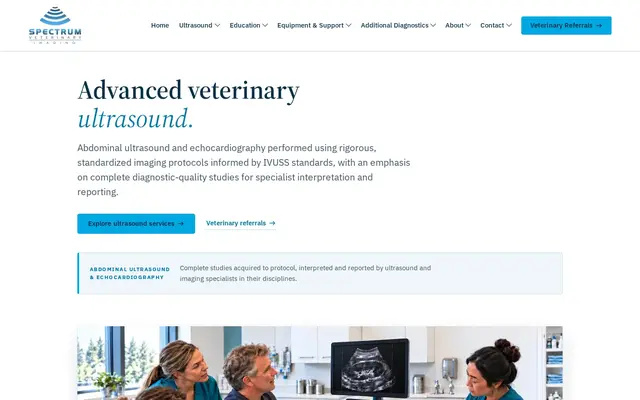 Spectrum Veterinary ImagingA veterinary ultrasound practice that needed a website, email and domains it could trust. We shipped a fully coded 23-page site in 14 days and moved everything underneath it onto secure, compliant infrastructure.
- Two storefronts, one year apartTwo locations, two measurement windows, and one of them went nowhere. Profile views nearly quadrupled and the actions that produce revenue grew with them - then a later month doubled impressions and moved clicks by three per cent.
- The SOS Group: three websites, results after handoverWe built three websites for The SOS Group and did the SEO, Google Business Profile and structured data work. The project ended in January 2026. These figures were measured between July and September 2026.
Bring your site. Leave with a plan.
A free 30-minute call with the founder. We review your site and your local market, then tell you straight what will bring in more work.
- A read of your current site and your local market
- A straight answer: a new site, SEO, or nothing yet
- The audit doc before the call, not after

Book a call · 30 min
Live availabilityTimes shown in your local zone.